
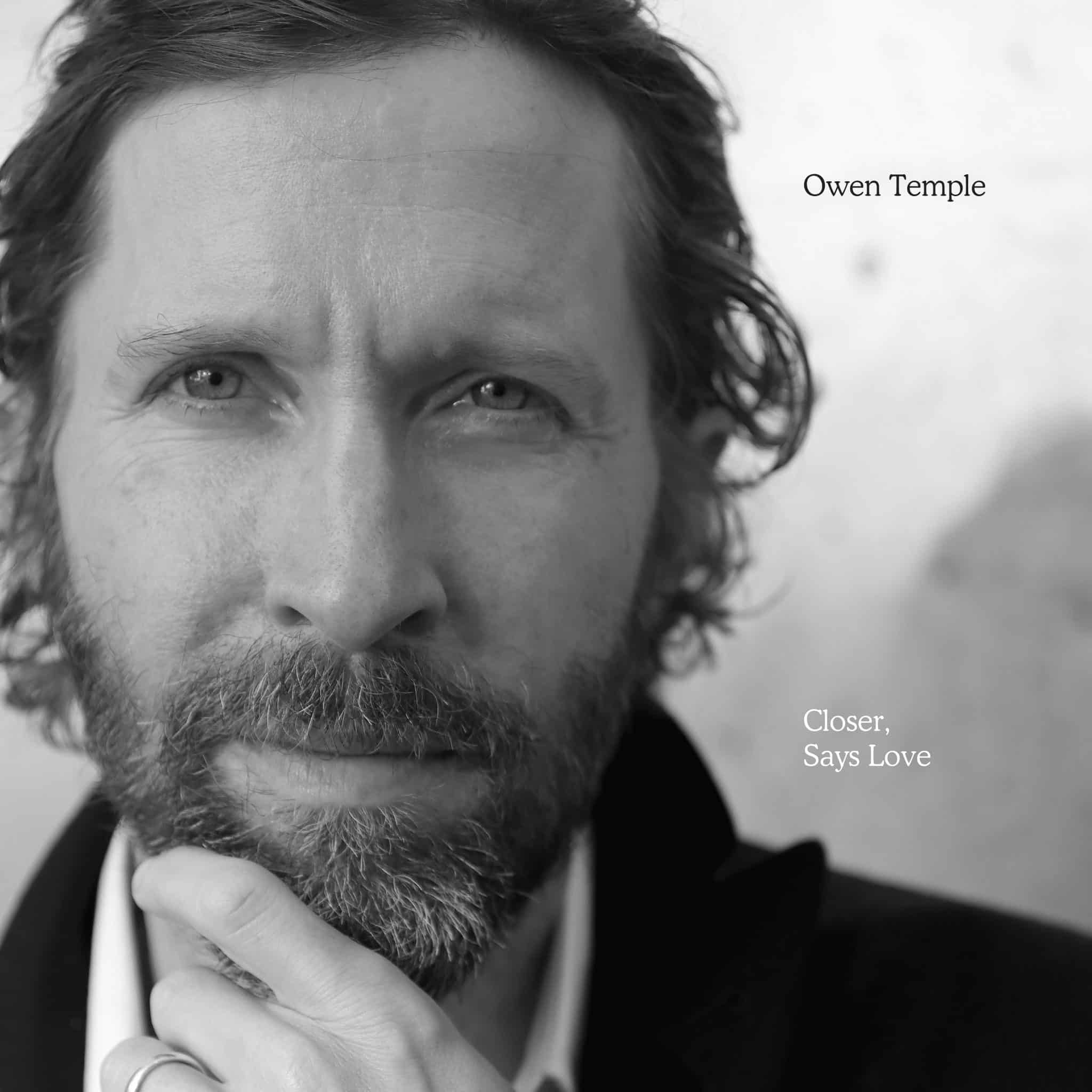
About the album
by Richard Skanse
Given the option between a shortcut or the scenic route, you can pretty much count on Owen Temple picking the latter. That, after all, is in theory the Way of all artists (writer, troubadour, painter, what have you) — or at least those seasoned enough to know that venturing off the beaten path can lead to new experiences and wellsprings of inspiration. But Temple doesn’t always favor taking the long way just for the sake of chasing the muse; sometimes he chooses it because it just feels like the right thing to do. Like the time he picked family over art, putting his busy touring and recording schedule on pause for the better part of a decade in order to focus on being fully present for the formative years of his two youngest children.
“Songwriting has always been important to me,” the native Texan insists. “But I’ve learned from my heroes. Remember in the documentary Be Here to Love Me, when Townes Van Zandt goes, ‘I realized I could really do this [music], but it takes blowing everything off …’? Family, friends, happiness — just ‘blow it off, get a guitar, and go.’ Well, what I decided to do was what I call a ‘Reverse Townes.’ I will do ‘this,’ but I will not blow off my friends and family.”
He says this with the smile of a man with no regrets, knowing he chose wisely. Revitalized and enlightened by the extended quality time with his closest loved ones, Temple resumed his music career full-tilt in 2023 with the ambitious 15-track concept album Rings on a Tree. And that was only the opening salvo in the most bountiful creative run of his life; so bountiful, in fact, that his 12th album, Closer, Says Love, could have easily been released a lot closer to Rings than now, three years later in the fall of 2026. That’s because Temple actually had the whole album “in the can” months ago. But being the head of his own record label (as he has been since his 1997 debut, General Store), he made the executive decision to artfully slow his roll and share it one piece at a time. You know, the scenic route.
“I wanted to take the time to tell the story of each song,” explains Temple, who digitally released the first single from the album (the rollicking “Fats Domino,” based on the true story of his late grandfather’s chance encounter with the legend) way back in December. Seven more followed over the course of the next nine months, ending with the prophetic (or rather, master-planned!) “Cooler Weather” at the end of September. All were released with their own Temple-painted watercolor cover art and stand-alone, introductory liner notes on his website and social media pages. And for the better part of a year, each single (and accompanying story) got its turn in the spotlight onstage, too, so that by late summer when Temple finally revealed that a new album was imminent, all but two of the songs had already passed the live test in the best way possible, for artist and audience alike. “Playing a big block of new songs all in one set would be too much, but working in a new one every couple of months keeps things fresh from show to show,” he says. “And it makes it fun to perform, too.”
Now, at long last, comes the big picture test, with all eight of those singles (along with two keepers Temple held in reserve) properly sequenced together to reveal Closer, Says Love in full. And make no mistake: This is very much an album album, every bit as thematically cohesive as Rings on a Tree before it. But it’s also the most freewheeling record that Temple’s ever made: a style-jumping joyride that careens carefree from the up-tempo blues shuffle of “Ain’t We Lucky” to the silky ’70s soul of “X-Ray Eyes” to the slow-loping, Lanois-and-Dylan-evoking hymn of “One and One is Three” to the aforementioned roadhouse-ready “Fats Domino” — all in the first 15 minutes alone. The only genre map Temple, producer/guitarist Gordy Quist, and the rest of the band followed in the studio (Austin’s The Finishing School) was the one they charted by feel and on the fly, twist by turn and song by song.
“We never said, ‘Let’s make a country record,’ or any one kind of genre, for that matter,” says Temple. “I really trusted the musicians, and didn’t want to foreclose on any interesting idea they might hit upon. I’ve studied David Lynch’s artistic process a bit, in which you really follow ideas and try not to ask why or argue against them very much. Because when you get creative people in a room together and stay open to experimenting and trying different things, the results can really be kind of exciting.”
Temple swears by that principle when it comes to co-writing, too. Seven of the album’s 10 songs were born that way, with Temple penning two (“X-Ray Eyes” and “Dangerous Game”) with Caroline Hale and one each with Quist (“Up North”), Gabriel Rhodes (“More Problems”), Jeff Burkhart (“Old Homeplaces”), and both Walt (“Turquoise Blue”) and Tina Wilkins (“One and One is Three”). The Tina Wilkins collaboration, one of the two tracks Temple kept under wraps until the full album release, is, fittingly, the song in which Temple sings the words “‘Closer,’ says Love” — a line he first heard in Jean-Luc Godard’s 1965 film Alphaville.
“The full quote, which the movie actually got from a French poem, was ‘Fear says “away,” but “closer,” says Love,'” says Temple. “I think all of the songs on the album embody that idea of, do you want to choose fear, or love? Because what you decide can really change your experience going forward.”
Spoiler: Temple will always choose the latter.
“I know there’s this philosophy of like, ‘The world doesn’t need any more love songs,'” he says. “But I kind of realized that the Creative Act is always about love, because you’re interested. So yes, a lot of these songs are about love in one sense or another. It could be, like in ‘Ain’t We Lucky,’ the love of just waking up in the morning and having your coffee. Or, in ‘X-Ray Eyes,’ about the kind of love where you can be yourself and don’t have to pretend with somebody. That’s love. Or, like in ‘One and One is Three,’ about how two people together can come up with something that’s bigger than just the two of them.”
Most listeners will naturally assume, not entirely off base, that Temple’s singing about family in that one. But that something “bigger” could just as easily be a tangible work of art, like two or more musicians or co-writers coming up with something unexpected and beautiful that none of them could have created on their own.
That’s love, too: Love for the sake of the song.
Produced by Gordy Quist
Engineered & Mixed by Steve Christensen
Recorded at The Finishing School, Austin, TX
Mastered by Chris Longwood
The Players
Owen Temple – Vocals, Acoustic Guitar
Gordy Quist – Harmony Vocals, Electric Guitar, Acoustic Guitar, Bass
Z Lynch – Bass
Clint Simmons – Drums, Percussion
Matt Tedder – Electric Guitar
Trevor Nealon – Piano, Organ
Caroline Hale – Harmony Vocals
Kelley Mickwee – Harmony Vocals
Cover photograph by Todd V. Wolfson
Album title after Paul Éluard, “Dit de l’amour”
All songs © 2025 Owen Temple
Owen Temple Music (BMI)
except:
“X-Ray Eyes” and “Dangerous Game” (Owen Temple & Caroline Hale)
“One and One is Three” (Owen Temple & Tina Mitchell Wilkins)
“More Problems” (Owen Temple & Gabriel Rhodes)
“Old Homeplaces” (Owen Temple & Jeff Burkhart)
“Turquoise Blue” (Owen Temple & Walt Wilkins)
“Up North” (Owen Temple & Gordy Quist)
℗ 2026 El Paisano Records