
On the fourth of May, 1791, in the church of Notre-Dame de l’Assomption at Les Cayes du Fond, on the southern coast of Saint-Domingue, a twenty-one-year-old signed his marriage act as J.n François Plunkett. His bride, Renée Rose Adélaïde Gentillot, was twenty. Two hundred and thirty-five years later I read the page they signed — the actual register, digitized by the French colonial archives — and it turns out that almost everything I thought I knew about this wedding was thinner than the truth, and the truth is better.
Start with who was standing in that church. The groom, baptized Jean François Achille, was legally still a minor, and his father was already dead — the act calls him “fils légitime de feu Sieur François Plunkett,” son of the late François. His mother had remarried. So the man standing beside him at the altar was his uncle and legal guardian, Étienne Boyer de Lagautraye, his mother’s brother. The bride’s side looked different: both of her parents were alive, present, and signing — her father Jean Désiré Gentillot was a lawyer, an avocat en parlement, and her mother signed with the wonderful compound signature Lefeburegentilot. The bottom of the act is crowded with names — Lafresselière and Lafresselière the younger, Gentilot de Lafresselière, Simon, Furmon, Duvau, Marrand — the whole intermarried planter world of the Cayes plain, turned out for a wedding.
And one line in the act mattered more than all the rest, though nobody in the church could have known it. The priest recorded a dispensation, granted a week earlier by the vice-prefect apostolic, from the impediment “du second au troisième degré de consanguinité en ligne collatérale.” Bride and groom were cousins — first cousins once removed — and the Church required the paperwork to say exactly how.
They were cousins because of a marriage arranged seventy-three years earlier. Renée Rose Le Pays was the orphaned daughter of a capitaine flibustier — a buccaneer captain, one of the sea-raiders the French crown was busy converting into planters. In 1718, at thirteen years old, she was married to Jean Baptiste Lefebvre des Hayes, a marine officer who had been baptized at Saint-Eustache in Paris, by the great markets of Les Halles, and had come out to the islands to become somebody. She bore him twenty children. Through their daughters, half the planter families of the southern plain became cousins of one another — including, eventually, the bride and groom of 1791. The bride even carried her grandmother’s name: Renée Rose.
The groom’s father had come from the other direction. François Plunkett was born in 1722 at Killummod, County Roscommon, into an old Irish Catholic family living under the Penal Laws — laws under which a Catholic could not buy land, could not take a commission, could not run a school. In the Census of Elphin of 1749, one of the few Irish census records to survive, the two Plunkett households of Killummod parish are entered in the religion column with a single abbreviation: Pap. — Papist. That notation is the reason for everything that follows. A man with no legal future in Roscommon took the road thousands of Irish Catholics took, out to a Catholic French colony, married a granddaughter of the old commandant, and died at Torbeck in 1771, when his son Achilles was two.
It has to be said plainly what this world was. These families were planters. Their rising fortune, from the 1720 census — which counts the Lefebvre household with twenty-six enslaved people and two indigo works — down to the sugar estate the Plunketts held at Torbeck, was built on the forced labor of enslaved Africans, in the most brutal plantation colony on earth. A man from a dispossessed people made his new fortune inside a system of dispossession incomparably worse than the one he had fled. Both of those things are true at once, and this story doesn’t work if either is left out.
Fourteen weeks after the wedding, the world those signatures belonged to ended. On the night of August 14, 1791, enslaved leaders met at Bois Caïman in the north, and within days the northern plain was burning. It was the beginning of the only successful slave revolution in history. The south came apart in its own sequence: in the summer of 1792 the enslaved people of the Cayes plain rose, and among the plantations they burned were the ones at Torbeck — the newlyweds’ own parish.
I used to write that the couple left “shortly after their marriage.” The tree can now do better than that: by September 3, 1794, they were in Wilmington, Delaware, because that is where and when their first child, a daughter they named Jeanne Geneviève, was born. A son, John Désiré — named for the lawyer grandfather back in Les Cayes — followed in Delaware in 1796. Then the family drifted down the seaboard the way the Saint-Domingue refugees did: a daughter, Mary Louise, born at Norfolk in 1806; and a son, Achilles Nivison — my four-times-great-grandfather — born at Williamsburg on October 10, 1810.
Renée died at Williamsburg around 1811, about forty years old, with a newborn son. I say “around” because no record of her death has been found yet — she is one of the open questions in this family, a woman proven vividly alive on a church page in 1791 and gone quietly from the record twenty years later.
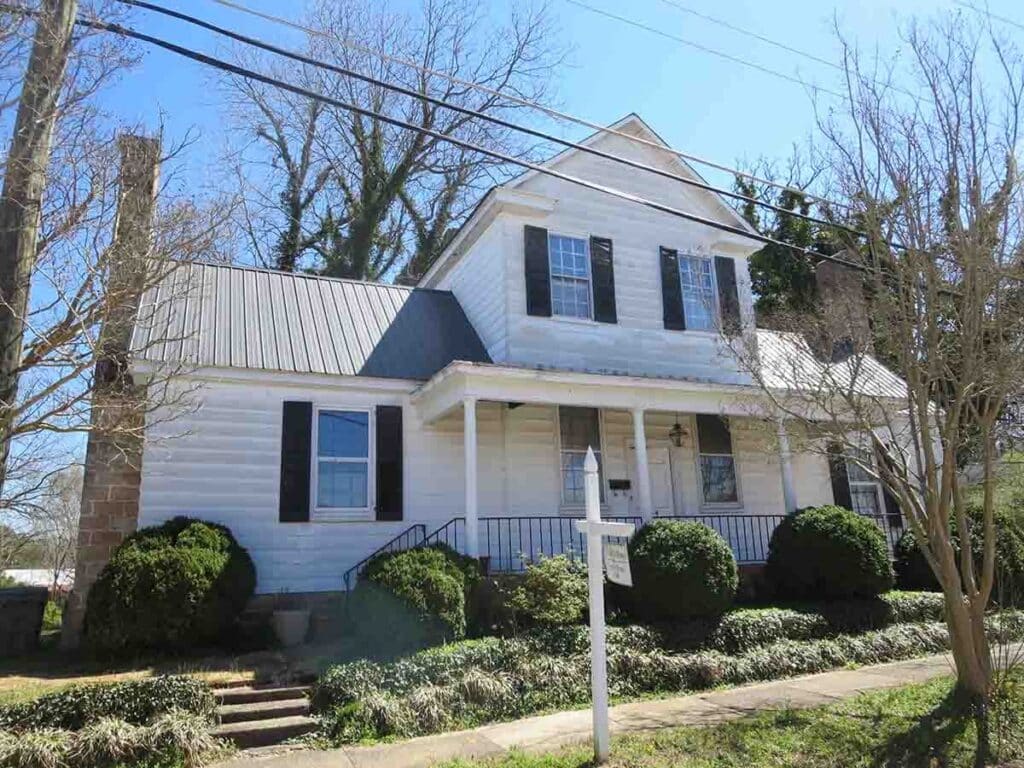
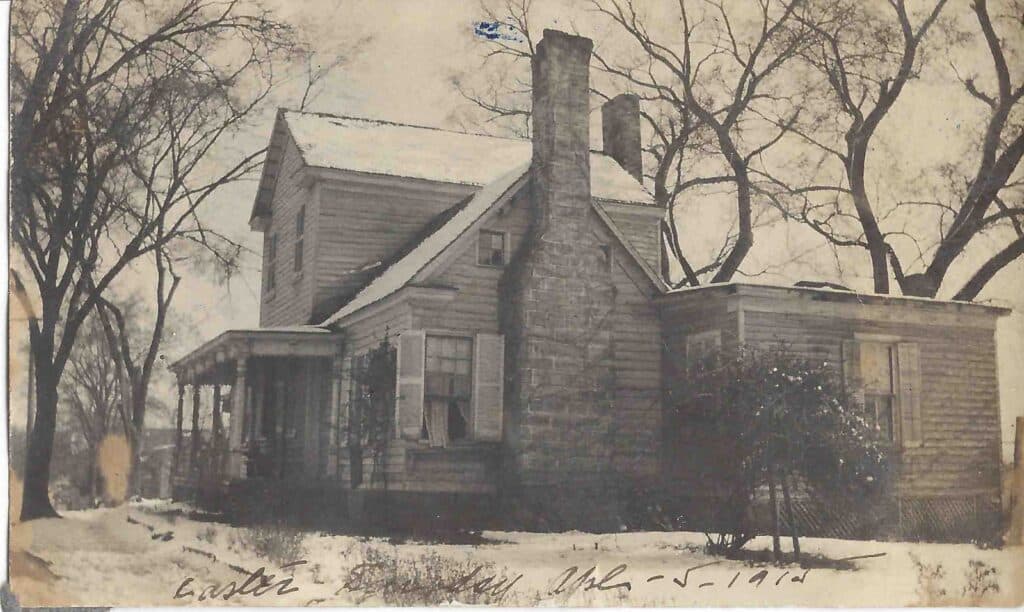
What Achilles did next is the part of the story I find hardest to stop thinking about. A widowed refugee planter in his fifties, he moved to Warrenton, North Carolina, and made his living from the accomplishments a Saint-Domingue gentleman happened to carry: he taught French, music, and dancing at the female academy there. In December 1820 he married Caroline Mordecai, the daughter of Jacob Mordecai, the school’s founder — she was twenty-six, he was fifty-one — and together they ran a school from the house in Warrenton whose photographs are below. They had three sons. All three died as infants. Achilles himself died at Warrenton on January 26, 1824, and his mother — the twice-widowed Marie Louise, born at Les Cayes in 1751, who had crossed the water with the family — outlived him, dying at Warrenton in 1830. She had buried two husbands, her son, and three infant grandsons on two sides of an ocean.
There is a postscript in the French archives that ties the whole family together in one sentence. In 1825 France extracted an indemnity from Haiti — payments to the former slaveholders, billed to the people who had freed themselves. In the register of that indemnity, under Torbeck, is the family’s sugar estate, called “Dite Romain,” at Boucan-Lafrance: 32,000 francs, awarded in 1831 to John Désiré, Achilles Nivison, and Mary Louise Plunkett as “seuls héritiers de leur grand-père” — sole heirs of their grandfather. One clause of a compensation ledger, written for reasons that had nothing to do with genealogy, confirms three generations of this family in a single line. The proof of the family’s structure sits inside the record of that injustice, and I won’t pretend the puzzle is charming without saying what the document is.
And that dispensation clause from the wedding? In 2026 it settled an argument I nearly got wrong. Two women in this tree — both Marguerites of the Lefebvre family — looked so much like one person entered twice that they were queued to be merged. The degrees of kinship in the 1791 dispensation only work if they were two different sisters; the 1825 indemnity register, with its separate estates and separate heirs, agreed. The priest of Les Cayes du Fond, writing out canon-law arithmetic on a May morning, saved a whole generation of this family from being deleted, two hundred and thirty-five years later, by the spreadsheet instincts of his own five-times-great-grandson.
A few things stay honestly open. His baptism — found at last in the Les Cayes register of 1769 — says he was born “in this parish,” while his marriage act calls him a native of Torbeck; the two acts disagree and I have let them. Renée’s death is still only “about 1811.” And someone named Lefebvre was buried at Les Cayes on June 14, 1788, who might close one more loop if the register ever gives up which sister she was. The research moves; the post will move with it.
The names crossed the water with them — Renée, Rose, Adélaïde — the way this family has always carried its lost places in its children’s names. Four generations after Torbeck burned, Achilles and Renée’s great-great-granddaughter Alice Plunkett was born at Des Arc, on the Grand Prairie of Arkansas, in 1893. She was my great-grandmother.
Achilles and Caroline ran their boarding school from this home (photos below) in Warrenton.
Read more about the Plunkett home from this real estate listing
This family’s full room — the people, the records, and what is proven and open — is at The Plunketts in the family wing, and the hardest puzzles are case files: the merge that would have destroyed a generation and the castle we tested and gave back.
Achilles Plunkett in the Temple Bond Catchings Johnson family tree on Ancestry — the tree is public, but Ancestry asks you to sign in.